Are you trying to choose the right air compressor for your workshop, factory, or job site in Central Queensland? With so many types on the market, selecting the right one can be challenging—especially when performance, cost, maintenance, and noise levels vary widely across models.
Whether you’re in manufacturing, agriculture, mining, or trades, understanding the key differences between air compressor types is essential. The right unit can improve your operations, support your tools and systems more effectively, and contribute to long-term cost control.
In this blog, we’ll explore the most common types of air compressors—rotary screw, piston (reciprocating), scroll, and oil-free—and offer guidance on choosing the right option for your needs.
What Are Air Compressors & Why Are They Important?
Air compressors convert power into potential energy by compressing air. This compressed air is then used to power tools, machinery, and other industrial systems. They’re commonly found in workshops, spray booths, construction sites, farms, and factories across Rockhampton and regional Queensland.
The type of air compressor you choose will affect:
- Tool performance and compatibility.
- Energy efficiency and running costs.
- Maintenance frequency and complexity.
- Noise and heat output in workspaces.
Rotary Screw Air Compressors
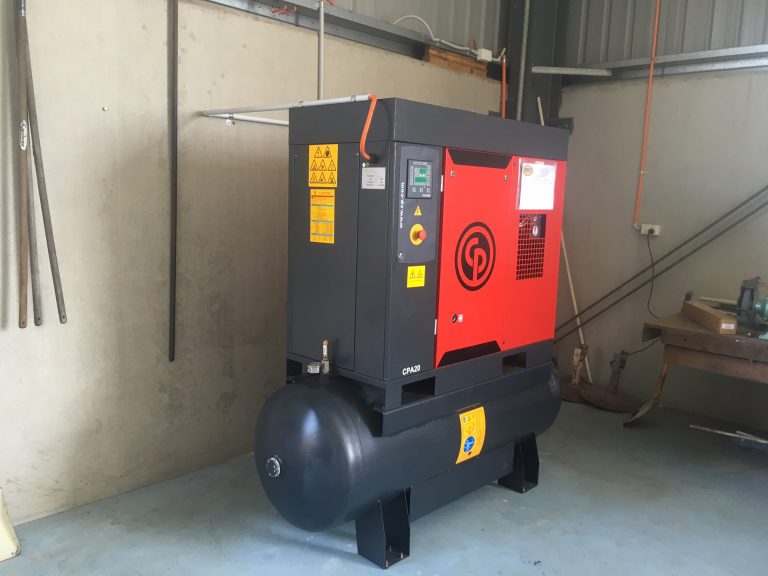
Rotary screw compressors are widely used in industrial and commercial environments. These compressors use two interlocking screws (rotors) to compress air in a continuous, smooth motion.
Key Features:
- Continuous operation: Ideal for 24/7 industrial use.
- Quiet running: Operates with less vibration and lower noise than piston models.
- Higher air output: Delivers a consistent air supply, suitable for multiple tools or machinery.
Pros:
- Long service life when maintained correctly.
- Energy efficient at high workloads.
- Suitable for high-duty cycle applications.
Considerations:
- Higher initial investment.
- Regular maintenance needed for oil and filters.
Best For:
- Manufacturing lines.
- Large workshops.
- Food processing facilities.
- Mining and construction companies requiring constant air pressure.
Piston (Reciprocating) Air Compressors
Piston compressors are one of the most common types used in small to medium operations. These systems work by using a piston inside a cylinder to compress air and store it in a tank.
Key Features:
- On/off cycle operation: Runs intermittently to recharge the tank.
- High pressure output: Suitable for short bursts of heavy air use.
- Compact options available: Easily stored in small work areas.
Pros:
- Lower upfront cost.
- Simple to maintain.
- Wide range of sizes available.
Considerations:
- Noisy operation due to piston movement.
- Generates more heat than rotary screw models.
- Less efficient in continuous use scenarios.
Best For:
- Small workshops and garages.
- Mobile tradespeople and service vehicles.
- Agricultural sheds.
- Low- to mid-volume air requirements.
Scroll Air Compressors
Scroll compressors use two spiral elements to compress air. One spiral remains stationary while the other orbits, creating continuous compression. These are known for their quiet and vibration-free operation.
Key Features:
- Quietest among standard compressor types.
- Compact design with fewer moving parts.
- Oil-free and low maintenance.
Pros:
- Ideal for noise-sensitive areas.
- Lower maintenance due to minimal wear.
- Consistent output for sensitive equipment.
Considerations:
- Typically higher in cost.
- Lower capacity compared to rotary or piston models.
Best For:
- Dental and medical clinics.
- Laboratories.
- Electronics manufacturing.
- Workshops needing low-noise environments.
Oil-Free Air Compressors
Oil-free compressors are designed to deliver clean, dry air without the risk of oil contamination. These can be rotary, piston, or scroll in design, but they’re specifically engineered to eliminate lubricants from the air stream.
Key Features:
- No oil required in the compression chamber.
- Delivers clean air suitable for food and pharma applications.
- Reduced environmental footprint.
Pros:
- Eliminates risk of oil contamination.
- Simplifies downstream air treatment.
- Suitable for hygienic or regulated industries.
Considerations:
- May require more frequent maintenance due to increased wear.
- Limited in continuous heavy-duty use unless high-spec.
Best For:
- Food and beverage industries.
- Medical and dental equipment.
- Cleanroom operations.
- Electronics manufacturing.
Choosing the Right Compressor for Your Operation
When selecting an air compressor, consider these five key factors to match the model to your application.
Duty Cycle
- Continuous operation? Rotary screw or high-spec oil-free models work best.
- Intermittent use? Piston or scroll compressors may be more cost-effective.
Noise Levels
- Scroll and rotary compressors operate quietly and are ideal for enclosed or shared spaces.
- Piston models tend to be louder but are acceptable in open sheds or outdoor setups.
Maintenance Requirements
- Rotary compressors require regular servicing (oil, filters).
- Piston compressors are easier to maintain but may require more frequent service depending on use.
- Oil-free and scroll models have fewer moving parts but must be serviced according to specific applications.
Air Quality Requirements
- For sensitive environments (food, medical), oil-free models are essential.
- General manufacturing or workshop environments can use standard oil-lubricated models with filtration.
Cost vs Longevity
- Initial cost is often lower for piston compressors.
- Rotary compressors and scroll units require more investment but may deliver better long-term value for high-use settings.
Industry Applications Across Central Queensland
Each sector in Rockhampton and its surrounds has different air demands. Below are common industry pairings with compressor types:
Mining & Heavy Industry
- Preferred: Rotary screw or high-capacity oil-free compressors.
- Reason: Continuous operation, remote sites, and demanding equipment.
Agriculture & Farming
- Preferred: Piston or rotary screw compressors.
- Reason: Versatile for spray painting, irrigation control, and general maintenance.
Manufacturing & Fabrication
- Preferred: Rotary screw compressors.
- Reason: Reliable supply of compressed air for tools and machinery on production lines.
Automotive & Trades
- Preferred: Piston or scroll compressors.
- Reason: Used intermittently for air tools, spray guns, and tyre inflation.
Medical, Dental & Laboratories
- Preferred: Scroll or oil-free compressors.
- Reason: Low noise and clean air requirements.
Explore Our Range of Air Compressors in Rockhampton
The right air compressor can support productivity, reduce downtime, and improve the lifespan of your equipment. Understanding the differences between rotary screw, piston, scroll, and oil-free models can help you make a more informed decision that aligns with your operational needs.
At Norosco, we stock and supply a wide range of air compressors in Rockhampton, suited to industries from agriculture to mining and manufacturing. Our team can guide you through the selection process to find a compressor that fits your application, duty cycle, and budget. Contact us today to explore the latest models and find the right air compressor for your Central Queensland operation.